

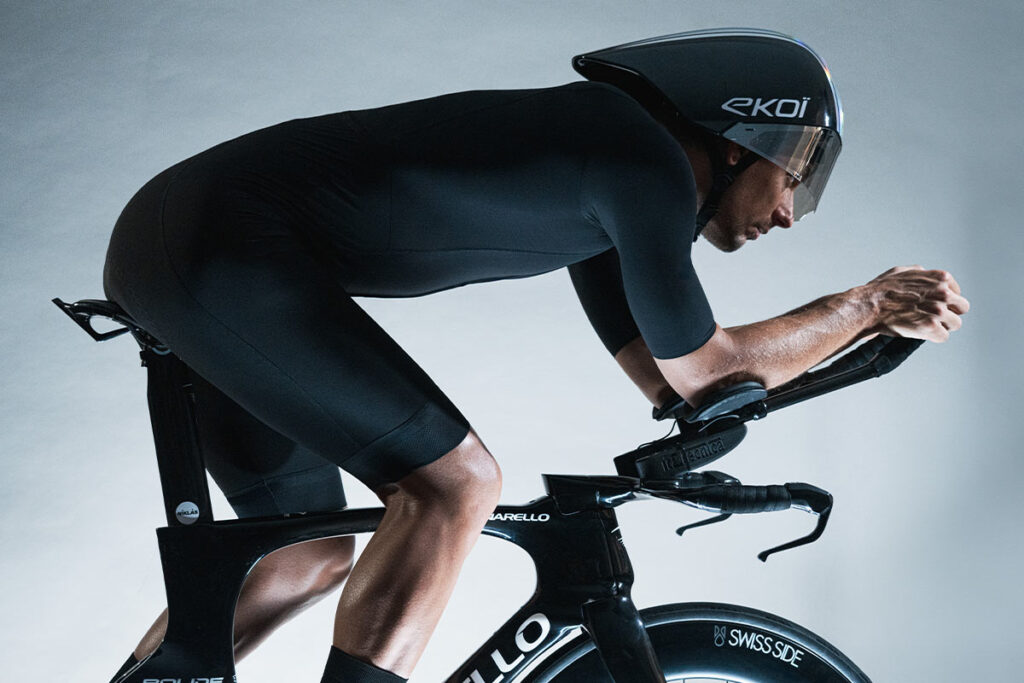
Elastic Interface® continues to develop discipline-specific solutions for cycling. Tailwind TT is the new cycling chamois designed specifically for time trial racing, addressing the demands of an aerodynamic position where body position, pressure distribution and the relationship between rider and saddle change significantly.
When it comes to cycling comfort, it is easy to assume that more padding automatically means more protection. It feels intuitive: a thicker cycling chamois seems softer, and therefore potentially more comfortable. But the relationship between the rider, the saddle and the chamois is far more complex.
Riding position changes. Pressure shifts. Some areas of the body carry more load than others, and the way a cyclist interacts with the bike can vary significantly from one discipline to another.
That is why the most useful question is not simply, “How much padding does this chamois have?” but rather: where is that protection really needed, and how should it perform?
This is where a more precise approach to cycling comfort begins. Not necessarily by adding more material, but by designing the chamois around body position, pressure distribution and the real demands of the rider.
Cycling comfort changes with body position
A cycling chamois sits at one of the most important contact points between rider and bike. During every ride, it has to manage pressure, movement, heat, moisture and stability at the same time. But those conditions are not always the same.
Think about the difference between a conventional road cycling position and the position adopted during a time trial.
In an aerodynamic TT position, the pelvis rotates forward and the rider moves towards the front of the saddle. As a result, pressure becomes more concentrated in the anterior area, while posterior contact is reduced.
This changes the way the cycling chamois needs to interact with the body. A solution designed around a more traditional riding position will not necessarily behave in the same way when a rider has to maintain an advanced, aerodynamic and highly stable position for an extended period of time.
This is one of the principles behind the Elastic Interface® approach: when the body changes position, the interface between body and bike needs to change with it.
Road cycling chamois vs time trial chamois: different riding needs
A long road ride and a time trial may both happen on high-performance bikes, but they place very different demands on the body.
During a typical road ride, cyclists tend to change position more frequently. They move on the saddle, stand on the pedals and adjust their posture according to terrain, speed and intensity.
In a time trial, the objective is different: maintain an advanced aerodynamic position as consistently as possible throughout a repetitive, high-intensity effort.
The pelvis remains rotated forward. Pressure is concentrated closer to the nose of the saddle, while the rear section of the chamois carries less load. This means the distribution of protection can also be reconsidered.
The goal is not simply to create a chamois with more padding. It is to design a discipline-specific cycling chamois that provides support exactly where the body needs it.
| Road cycling chamois | Time trial chamois |
| More frequent changes in riding position | More stable aerodynamic position |
| More variable pressure distribution | Greater pressure towards the front of the saddle |
| Designed for different riding situations | Designed for a specific riding position |
| Greater freedom to move on the saddle | Greater focus on stability and control |
Why a thicker cycling chamois is not always more comfortable
When choosing cycling shorts or bib shorts, many riders instinctively evaluate the chamois by touching it.
Softness and thickness are immediately noticeable, which makes them feel like natural indicators of comfort.
But that first impression only tells part of the story.
In a highly specific position such as time trial racing, excessive compression can introduce small movements between the rider and the saddle. Even minor oscillations may lead to repeated postural adjustments, disrupting position stability and the consistency of the pedal stroke.
Cycling comfort therefore depends on more than pressure absorption. It also depends on stability, control and the precision of the contact point.
In some disciplines, reducing thickness can actually be a functional design choice: less volume in low-load areas and more targeted protection exactly where it is needed.
Tailwind TT: a cycling chamois designed around the time trial position
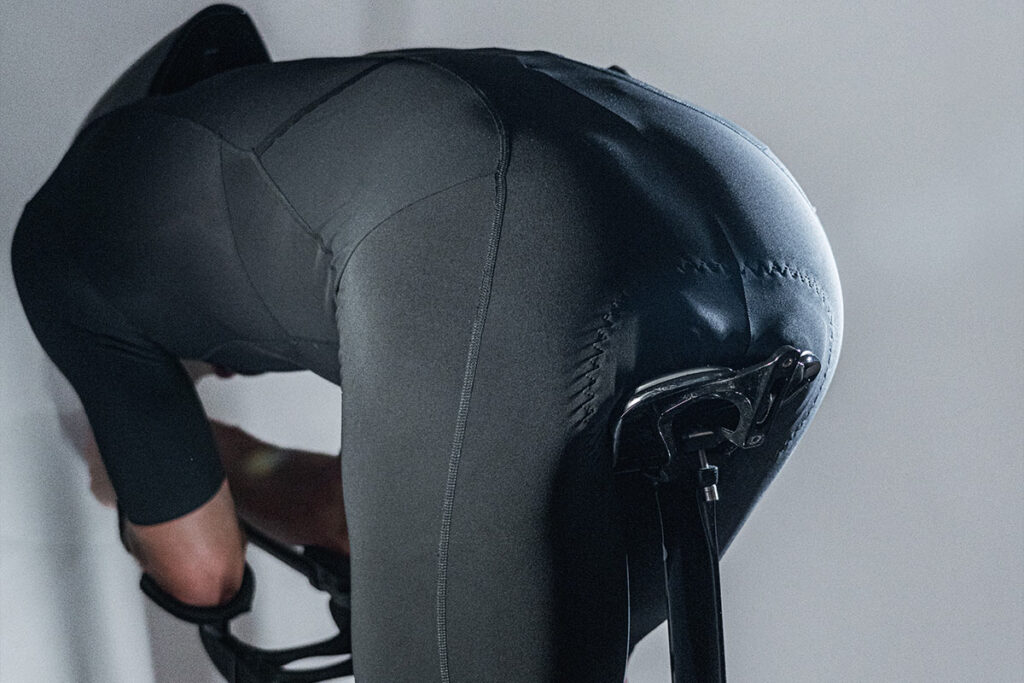
This approach led to the development of Tailwind TT, the Elastic Interface® cycling chamois created specifically for time trial racing.
Rather than adapting a traditional road chamois to a new discipline, the design starts with the athlete’s position and what happens to the body as it moves forward on the bike.
Protection is concentrated in the anterior area, where pressure is higher, while thickness and volume are reduced in less loaded zones. Its compact construction is designed to limit unnecessary interference and support a stable position throughout the effort.
This creates a different way of thinking about comfort: not as the amount of material used, but as the precision with which support is distributed.
In other words, when the body moves forward, support follows.
Less material can mean less interference
A more essential chamois architecture is not only about reducing weight or thickness.
Lower volume can also mean fewer overlapping layers, fewer folds and less surface potentially exposed to friction. In a time trial position, where the body remains relatively static for long periods, heat and moisture management also become particularly important.
Tailwind TT is designed around these specific demands. Its construction reduces unnecessary material while maintaining support in the areas carrying the greatest load and allowing more freedom in zones where less protection is required.
The result is a different interpretation of functional cycling comfort: not adding more, but placing exactly what the rider needs exactly where it is needed.
What is inside the Tailwind TT cycling chamois?
Behind such a thin and compact cycling chamois is a combination of materials and technologies, each with a specific role.
The surface in contact with the skin uses Eco MAX fabric, while the main anterior support is provided by a high-support RET D90 reticulated foam. A second, lighter reticulated foam layer contributes to breathability and moisture management.
The system is completed by Elastic Interface® Refined Edge technology, designed to create smoother transitions around the perimeter of the chamois, reducing unnecessary bulk and helping the pad integrate more naturally into the garment.
A thermo-moulded, dual-density construction brings these elements together in a compact system designed specifically for the discipline.
Once again, the real question is not how much padding a cycling chamois contains, but where that padding is placed, how it performs and why it is there.
Choosing cycling bibs also means understanding the chamois
When comparing cycling shorts or bib shorts, attention often goes first to the fabric, fit, straps or overall design.
The chamois deserves just as much attention.
Understanding which discipline and riding position it was designed for can help riders make a more informed choice.
A cycling chamois designed for long-distance riding has different requirements from one developed for a time trial. In the same way, an advanced aerodynamic position creates very different conditions from a more variable posture during a long road ride.
This does not mean that there is one cycling chamois that is “better” in absolute terms. It means that a chamois can be better suited to a specific riding style, position and discipline.
This is where the Elastic Interface® concept of discipline-specific design becomes particularly relevant for riders. Comfort is not defined by one universal formula. It depends on how effectively a product responds to the real conditions in which it is used.
The right cycling chamois is not simply the one with “more”
Thicker. Softer. More padded.
These are easy characteristics to perceive, but on their own they do not define the quality of a technical cycling chamois.
A more useful question is whether the product has been designed for the way you ride.
Is protection positioned where your body actually needs it?
Is the structure compatible with the position you maintain on the bike?
Does the chamois manage ventilation, moisture and freedom of movement in a way that suits your discipline?
True innovation does not always come from adding something.
Sometimes it comes from understanding more precisely what is needed, where it is needed and when it is needed.
From the body to the product
A new cycling product can begin with a material, a technology or a manufacturing process.
Tailwind TT begins with a question about the body.
What changes when the pelvis rotates forward? Where does pressure increase? Where is protection still necessary, and where can material be reduced?
Observing these changes shaped the design of the chamois.
It is an approach that captures the Elastic Interface® philosophy: innovation does not start with the product. It starts with the body.
First, observe the rider. Then understand the specific demands of the discipline. Finally, select the materials, geometries and construction that respond to those needs.
Tailwind TT was developed around exactly this idea: creating a cycling chamois specifically engineered for the time trial position, bringing biomechanics, technology and product design together in one integrated system.
Thin. Stable. Fast.
Built for bodies. Engineered against the clock.
Discover how cycling comfort changes when your riding position changes.
Tailwind TT is the Elastic Interface® cycling chamois developed specifically for time trial racing, with targeted support, a compact design and protection engineered around the aerodynamic position.