

There comes a point on every long ride when small details stop feeling small.
A little too much pressure. Heat building up inside your bib shorts. Moisture that does not disappear quickly enough. A pad that suddenly feels bulkier than it did at kilometre twenty.
When hours in the saddle add up, comfort becomes part of performance.
For decades, cycling chamois design has relied on foam to provide protection between the rider and the saddle. But what if comfort could be engineered differently?
That question led Elastic Interface® to develop AURA N3X® FL, the world’s first FoamLess chamois.
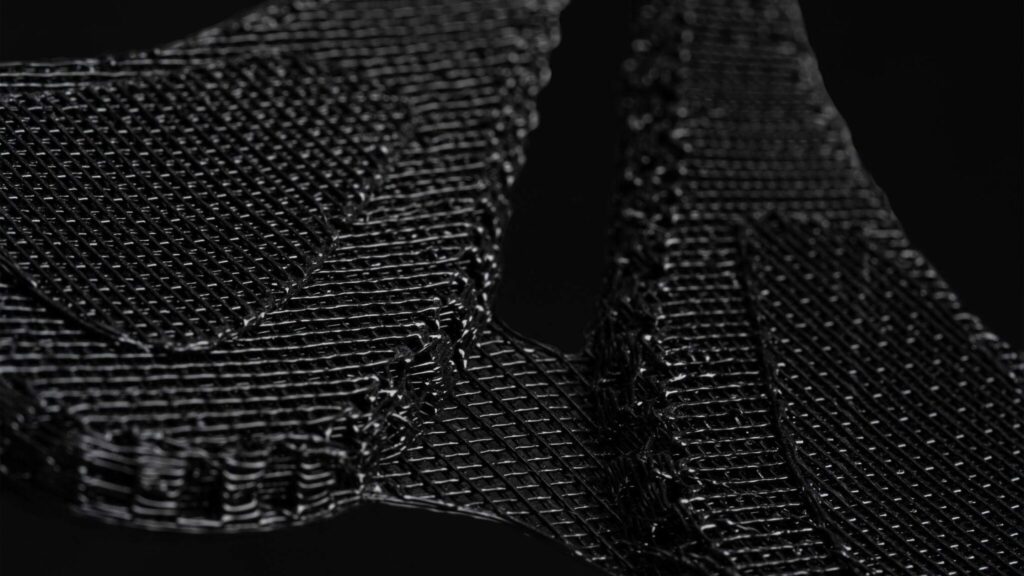
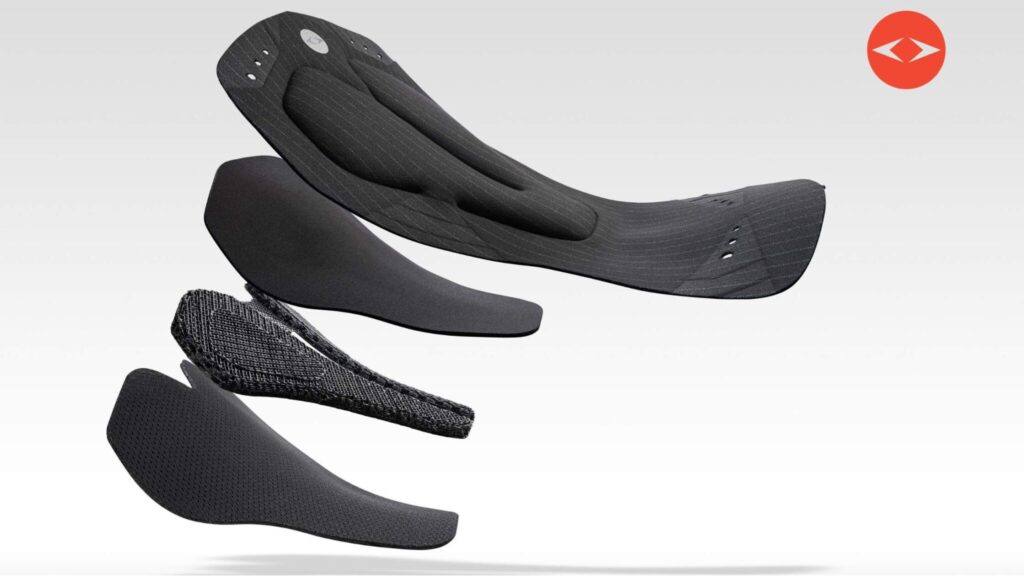
No polyurethane foam. No laminations. Instead, 3D-printed inserts and technical textile materials work together as an integrated system designed around the way cyclists actually move.
FoamLess does not mean less comfort. It means rethinking how comfort is built. And that question points towards a broader one: what could the cycling chamois of the future look like?
Why cycling chamois technology matters more than you think
Your cycling pad sits at one of the most important contact points on the bike.
Every pedal stroke involves pressure, movement, heat and moisture in the area where your body meets the saddle. That makes the chamois much more than a soft layer inside a pair of bib shorts.
A well-designed cycling pad needs to manage several demands at the same time:
- provide support where the body needs it
- allow freedom of movement
- help control pressure
- manage moisture and remain stable throughout the ride.
And those requirements change depending on the cyclist, the riding position and the discipline.
A long endurance ride is not the same as a time trial. Riding for several hours places different demands on the body than maintaining an aggressive aerodynamic position against the clock.
This is why at Elastic Interface® we design comfort by starting with the rider.
Built for bodies.
What exactly is a FoamLess cycling chamois?
Traditional cycling pads generally build protection through different foam layers. AURA N3X® FL takes another route.
It eliminates polyurethane foams and laminations, combining 3D-printed inserts with technical textile materials.
The three-dimensional structures are not simply substitutes for foam. Their geometry can be engineered to perform different functions in different areas of the pad.
Support can change. Elastic response can change. Ventilation can change.
All within the architecture itself.
Traditional and FoamLess cycling chamois: what changes?
| Feature | Tradional cycling pad | FoamLess approach |
| Construction | Foam layers and conventional laminations | 3D-printed inserts and technical textile materials |
| Support | Shaped through foam density and layering | Engineered through three-dimensional geometry |
| Ventilation | Influenced by materials and construction | Integrated into the open 3D structure |
| Geometry | Primarily defined by the shape and layering of the padding | Variable geometries can be designed for different zones |
| Design philosophy | Protection built through padding | Functional properties engineered within the structure |
The role of N3X® technology
AURA N3X® FL represents a new evolution of Elastic Interface®N3X® Technology.
N3X® introduced 3D printing into cycling-pad construction, allowing structures to be engineered with variable geometries rather than relying exclusively on conventional padding materials.
With AURA N3X® FL, that approach moves further.
The 3D-printed structures can be designed to modulate properties such as support, elasticity and ventilation according to the needs of different zones.
For a cyclist, the technology becomes interesting not because of how futuristic it sounds, but because of what it is designed to do during the ride.
The objective is simple: manage the interaction between body and saddle more precisely.
Breathability becomes part of the structure
Anyone who rides hard knows that saddle comfort is not only about pressure.
Temperature and moisture matter too.
During endurance riding or high-intensity efforts, the microclimate inside cycling shorts can have a significant influence on how comfortable you feel.
AURA N3X® FL combines its open 3D structure with technical textile materials and Eco AirTech, supporting air permeability, moisture management and fast drying.
Rather than treating ventilation as an additional feature, the construction integrates it into the pad’s architecture.
The result is a cycling chamois designed to support breathability together with pressure management and stability.
When the ride gets harder, that matters.
Why removing foam can create new possibilities
At first, “FoamLess” may sound like a story about taking something away. It is actually a story about redesign.
By eliminating polyurethane foam and laminations, AURA N3X® FL reduces the number of materials involved in the construction. Its 3D-printed inserts are also produced without material waste.
But material reduction only makes sense if performance remains at the centre.
That is why the goal of AURA N3X® FL is not minimalism for its own sake.
It is to create a more essential construction while delivering the qualities cyclists expect from advanced riding equipment: support, breathability, pressure management, stability and freedom of movement.
FoamLess is not a reduction. It is a new construction logic.
What does FoamLess technology mean for the rider?
Technology matters when you can stop thinking about it.
On the bike, AURA N3X® FL is designed around the demands of long rides and high-intensity endurance performance.
Its construction aims to provide consistent support while allowing the rider to move naturally throughout the pedal stroke.
The open structure also contributes to airflow and moisture management, while the reduction of traditional layers creates a lighter and less complex architecture.
For the cyclist, all these elements point toward the same objective: more freedom to focus on the ride.
Because the best cycling equipment should not constantly remind you that it is there. It should help you keep going.
3D printing is only part of the story
It can be tempting to look at a new material or manufacturing process and assume that the technology itself is the innovation.
At Elastic Interface®, the starting point is different. The question is not: what can we make with 3D printing? It is: what does the rider need?
That philosophy has guided Elastic Interface® since the introduction of the elastic cycling chamois in 2001 and continues through today’s technologies and discipline-specific products.
3D printing becomes valuable when it allows designers to control the behaviour of the product more precisely.
Different geometries can answer different functional needs.
Different riding positions can require different protection.
Different disciplines can demand different solutions. Innovation starts with the body.
How to choose cycling bib shorts for better comfort
When cyclists compare bib shorts, attention often goes first to the fabric, straps, fit or graphics.
The cycling chamois deserves just as much attention: it is the technical interface between your body and the saddle, and its design directly influences comfort and performance.
Before choosing your next pair, ask what type of riding the pad has been designed for.
Are you riding fast for one hour or exploring for six? Road, gravel or time trial? Do you need maximum freedom of movement, targeted support or advanced moisture management?
Instead of looking only for “more padding”, look for a pad whose design matches how you ride.
More material does not automatically mean more comfort. The right architecture matters more than sheer volume.
As cycling-pad technologies evolve, riders can begin to evaluate bib shorts in a new way: not simply by asking how thick the chamois is, but by understanding how intelligently it has been engineered.
Beyond foam. Beyond limits.
Cycling has always evolved by questioning things that once seemed fixed:
- frames became lighter
- aerodynamics became more sophisticated
- fabrics became more technical
- training became more scientific
Now, even one of the most familiar components inside a pair of cycling shorts can be reconsidered.
With AURA N3X® FL, Elastic Interface® takes cycling comfort beyond the traditional logic of foam padding and explores a new relationship between structure, materials and the body.
For us, innovation is never about technology for technology’s sake. It is about making every contact point with the bike work better for the person riding it.
So the next time the road stretches ahead for another fifty kilometres, comfort can do what it is supposed to do: help you think less about the saddle, and more about where the ride can take you.
Ready to go beyond foam? Discover a new dimension of cycling comfort, engineered for support, breathability and freedom of movement. Discover AURA N3X® FL.