


Women’s cycling is changing. And it is changing fast.
More women are riding, training, travelling, racing and exploring different cycling disciplines: road, gravel, off-road, endurance and ultra-distance. This growth is not only numerical. It is cultural. Women’s cycling is becoming more visible, more competitive and more aware of its technical needs.
In 2024, Strava reported an 11% increase in the share of female cyclists on its platform, while the 2026 UCI Women’s WorldTour calendar includes 27 events across 11 countries. These are clear signals: women’s cycling is no longer a niche. It is a development direction for the whole industry.
But if the way women experience cycling is evolving, the way products are designed has to evolve too.
Because women’s comfort cannot be treated as a simple variation of a men’s product.
Comfort is not a matter of size.
For many years, in the world of sport, a “women’s product” was often interpreted as a smaller, softer or simply differently colored version of a men’s product. In cycling, this logic is especially limiting.
The point of contact between the body and the bike is one of the most delicate areas of the entire riding experience. A cycling pad has to protect, support, follow movement, reduce pressure, improve breathability and contribute to comfort over time.
For women, all this requires a dedicated approach.
Elastic Interface® designs its cycling pads starting from anthropometric parameters and from the study of anatomical differences between men and women. The ChamoisTech catalogue highlights that women have greater anatomical variability, a wider pelvis and a different pubic area conformation, all of which influence the way pressure is distributed on the saddle.
The result is a simple but essential principle: a women’s cycling pad should not adapt to a generic idea of comfort. It has to be designed around the real body of the female rider.
Why pressure relief is central to women’s cycling.
When we talk about comfort in the saddle, we are not only talking about padding. We are talking about pressure, friction, sweat, sensitivity and time spent on the bike.
A study published in Frontiers in Sports and Active Living analyzed female cyclists’ experience of saddle sores, highlighting the role of pressure, friction and sweat as factors associated with saddle discomfort. The study also shows how these issues can affect riding enjoyment, training and performance.
This confirms a key principle in cycling pad design: comfort does not come from adding more material. It comes from placing it with precision.
An effective chamois has to distinguish between areas that need support and areas that need relief. It has to protect the points most exposed to pressure while reducing unwanted compression in the most sensitive zones. It has to maintain stability without limiting the natural movement of pedaling.
This is where women-specific design becomes a true design discipline.
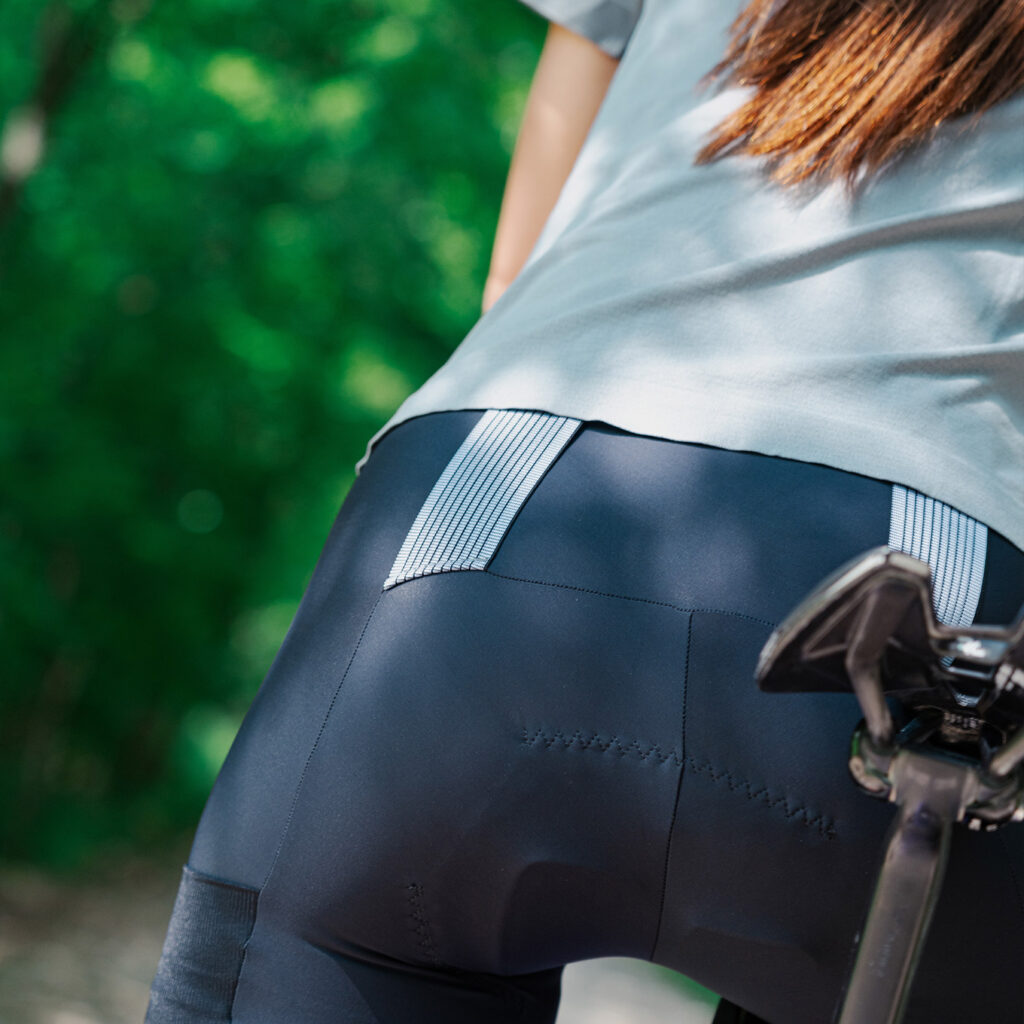
WP1, WP2 and WP3: three architectures for different needs.
Elastic Interface® has developed three constructions dedicated to women’s cycling: WP1, WP2 and WP3.
They are not three aesthetic variations. They are three different comfort architectures, designed to respond to the greater variety of women’s anatomy and to different levels of protection and pressure relief. The catalogue describes WP1, WP2 and WP3 as constructions developed to support the rotation of the pelvic bones while pedaling, with padded areas and relief areas that vary according to each chamois design.
- WP1 is designed for riders who need more substantial and continuous support in the perineal area.
- WP2 combines perineal support and pressure relief, offering protection and relief at the same time.
- WP3 is developed for women who are extremely sensitive to compression. It uses thinner and lower-density foams in the genital area to minimize pressure, with raised ischiatic padding and medium-density padding in the perineal area.
This structure makes it possible to move beyond the idea of one single “women’s chamois”. Female cyclists do not all have the same needs. Anatomy, saddle position, discipline, ride duration, individual sensitivity and comfort expectations all change from rider to rider.
That is why women-specific comfort is not a single product.
It is a design system.
Every discipline changes how the body meets the saddle.
Cycling is not one single movement. Each discipline changes body position, pressure points and the type of protection required.
On the road, a more aerodynamic position shifts weight forward. In gravel riding, the cyclist often changes posture according to terrain, speed and control needs. In off-road riding, the body constantly moves between seated and active positions, while vibrations and impacts increase stress in the ischiatic area.
Elastic Interface® studies different saddle positions for each discipline, analyzing the main pressure points and adapting densities, materials and chamois construction to the intended use.
This approach is essential in women’s cycling, because truly effective design has to bring together two levels: the anatomy of the female rider and the specific demands of the discipline.
| Discipline | Body position | Main requirement |
| Road | More aerodynamic and stable | Consistent support and pressure distribution |
| Gravel | Variable and dynamic | Dynamic comfort and freedom of movement |
| MTB (Off-road) | Highly dynamic and active | Protection and stability under impact and vibration |
Road: precision, support and movement.
In road cycling, comfort has to remain stable over long distances, through repeated pedaling motion and high-moisture conditions. Here, the challenge is not only to protect, but to protect with precision.
Icarus Women Hybrid is an example of this approach. Designed for road long-distance riding, it integrates WP1, Air Floating Technology, Hybrid Cell System insert, zero-friction wings, front and back perforations and EIT BIO PRIME. Its construction is developed to offer freedom of movement, breathability and support over long distances, while the floating core helps expel moisture and naturally adapts to different anatomies.
In road cycling, women’s comfort is not only about softness.
It is pressure distribution.
It is stability.
It is the ability to support the body where needed and relieve it where it matters.
Gravel: comfort that follows movement.
Gravel is a hybrid discipline by nature. There is no single position: the rider stands, lowers the body, shifts back, moves forward, changes rhythm and adapts posture according to terrain.
That is why a gravel cycling pad has to support movement, not restrict it.
Gravel Performance Women WP3 Hybrid is designed for the longest gravel rides, with an anatomic and pre-shaped construction developed to follow every movement of the cyclist. It integrates WP3, long Hybrid Cell System inserts, perforated base padding and Eco X-Fifty recycled fabric to support comfort, breathability and quick drying on changing terrain.
In this case, WP3 becomes particularly relevant because it responds to the needs of riders who are more sensitive to compression. In gravel riding, where position and pressure are constantly changing, comfort has to be dynamic.
The body adapts to the terrain.
The chamois has to do the same.
Off-road: impact, stability and ischiatic protection.
In off-road riding, the body is exposed to constant stress. The bike reacts to the terrain, the rider moves continuously and pressure tends to concentrate more in the ischiatic area.
Here, the cycling pad has to combine protection and freedom of movement.
MTB Trail Women Hybrid is designed to follow the MTB athletic gesture. It uses specific Hybrid Cell System inserts in the ischiatic area, anatomic and pre-shaped construction for saddle stability, Air-Mapping System, Super Air layers and a fabric-only top to help keep the skin dry and comfortable during dynamic riding. Its WP2 construction provides perineal support and pressure relief at the same time.
This proves another important point: women-specific design should not stop at road cycling. It has to extend across every discipline, every riding position and every type of experience.
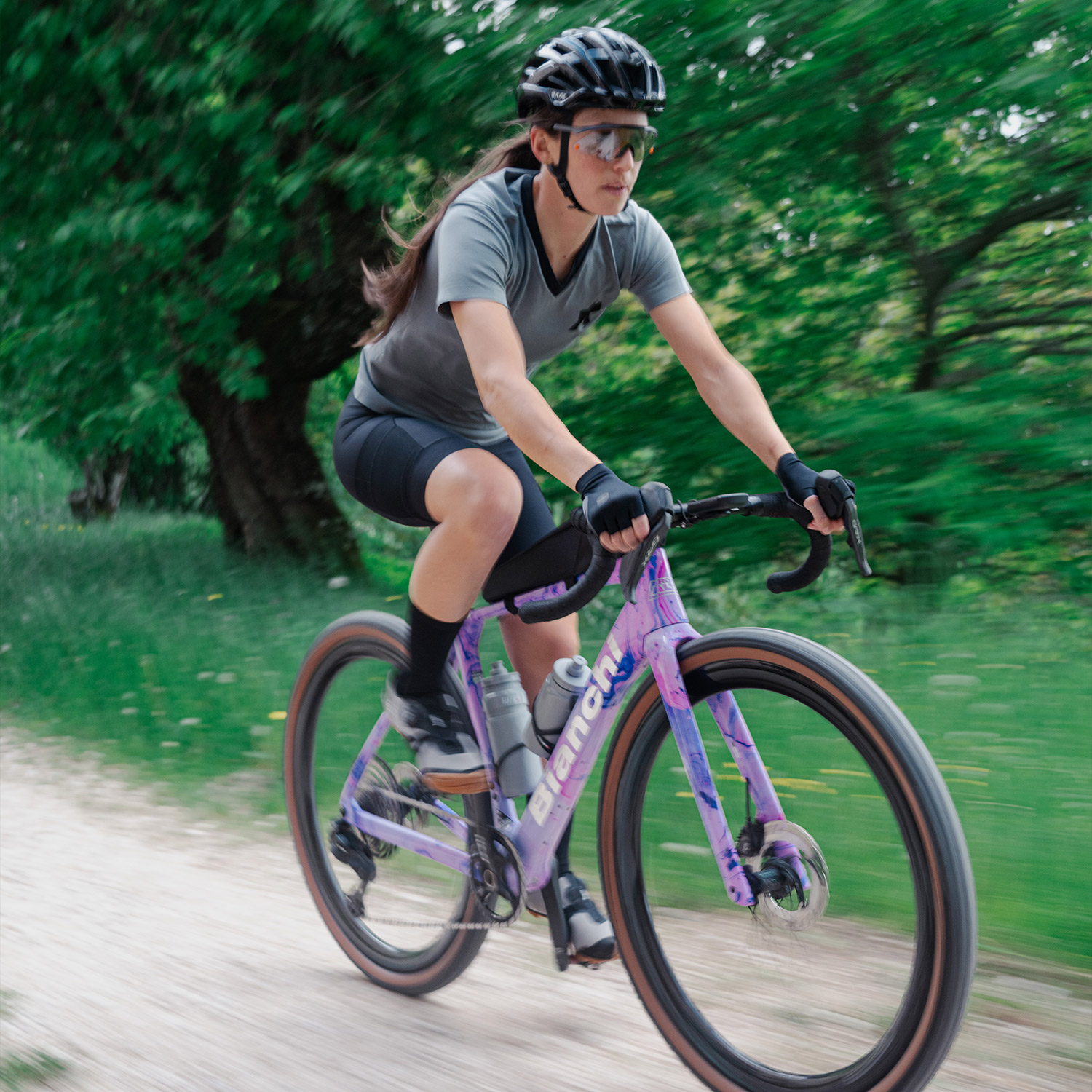
Nova Women: a direction, not a simple variation.
Within this vision, Nova Women represents a manifesto of Elastic Interface®’s focus on women’s cycling comfort.
Developed for Granfondo riders, professional cyclists and long to ultra-long distances, Nova Women combines Eco STREAM recycled polyester microfiber, D65 BIO Super Air foam, D110 RET foam, D120 foam, Evologic® Focus technology, smooth transitions and pre-shaped wings.
Not simply a women’s version, but the result of dedicated research into female anatomy and the real needs of female riders.
Nova Women clearly reflects where the market is heading: female cyclists are looking for products that support performance, distance, comfort and well-being over time. It is not enough to “adapt” an existing chamois. Design has to start from the body.
The future of women’s cycling comfort is an opportunity for brands.
The growth of women’s cycling creates a major opportunity for brands in the industry: designing products that are more precise, more inclusive and more relevant.
But to do this, brands have to move beyond a simplified view of the female target. Female cyclists are not one single segment. There are road cyclists, gravel riders, mountain bikers, endurance athletes, enthusiasts, professionals and advanced beginners. Each of them brings different needs to the saddle.
The future of women’s cycling comfort will increasingly be shaped by research, anatomy, discipline-specific design and the ability to listen to real rider needs.
For Elastic Interface®, this means building cycling pads that do more than protect. It means designing the interface between body and bike with precision, responsibility and vision.
Because women-specific comfort is not a detail.
It is a design direction.
And as women’s cycling continues to grow, the question for brands becomes clearer: are products truly designed around the female riders who will use them?
Jump into performance. Discover in detail the technologies behind women’s chamois and the key strengths of Elastic Interface® cycling pads, engineered for maximum comfort on road, gravel and off-road rides.
Sources: